The substrate
| Spec | Value |
|---|---|
| Diameter | 4 in (100 mm) silicon wafer |
| Orientation | ⟨100⟩, the crystallographic orientation of the silicon crystal |
| Oxide | 300 nm wet thermal oxide (SiO₂ grown by thermal oxidation with water vapor) |
| Thickness | 525 µm |
| Polish | SSP, single-side polished |
| Type / dopant | P-type, boron-doped |
SC-1 (RCA-1) clean
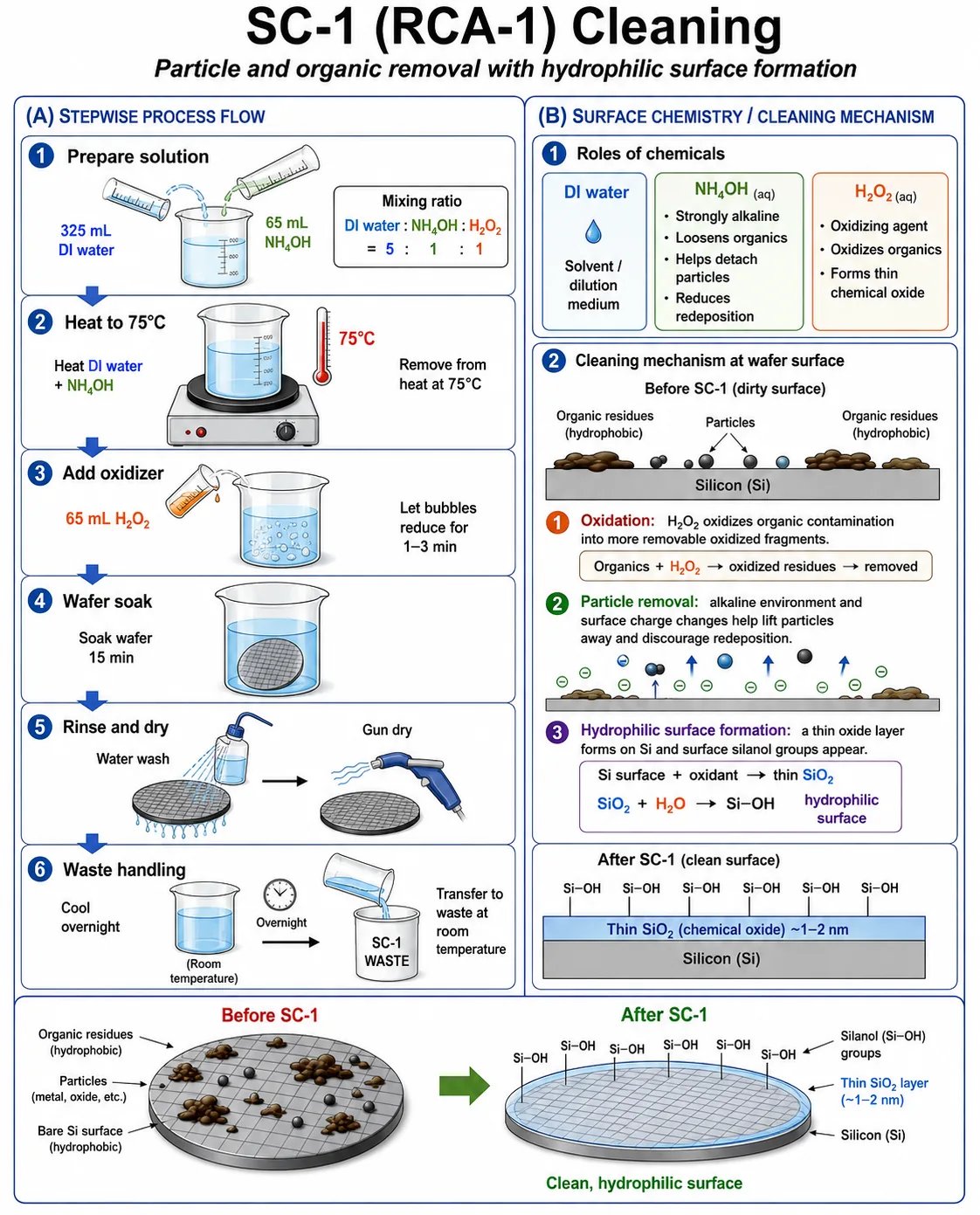
SC-1 removes organic contamination and particles from the wafer surface, leaving a clean, hydrophilic surface.
DI water : NH₄OH : H₂O₂ = 5 : 1 : 1
- DI (deionized) water is the solvent and base of the solution. It dilutes the reactive chemicals to the intended concentration.
- NH₄OH (ammonium hydroxide) makes the solution strongly alkaline. It loosens organic contamination, helps detach particles, and changes the surface charge so particles are less likely to redeposit.
- H₂O₂ (hydrogen peroxide) is the main oxidizer. It oxidizes organic and some metallic contaminants, makes them easier to remove, and grows a very thin chemical oxide that leaves the surface hydrophilic.
Procedure
- Prepare the base solution. Add 325 mL DI water and 65 mL NH₄OH to a clean glass container.
- Heat to 75 °C, then remove from heat. Heating speeds up the cleaning reactions.
- Add 65 mL H₂O₂ immediately. H₂O₂ provides strong oxidation while NH₄OH keeps the solution alkaline.
- Let the bubbling settle for 1–3 minutes. The solution reacts vigorously after the H₂O₂ goes in, and letting it settle gives a more stable bath.
- Soak the wafer for 15 minutes. H₂O₂ oxidizes organic contamination and the wafer surface while NH₄OH loosens particles and oxidized residue. The alkaline solution changes surface charge to keep detached particles away, reducing redeposition.
- Rinse with DI water and dry with an N₂ gun. The rinse removes SC-1 chemicals and loosened contaminants.
- Waste handling. Let the SC-1 solution cool overnight, then dispose of it in the proper waste container once it reaches room temperature.
Result: a clean, hydrophilic surface with a thin chemical oxide.