Resist type
AZ / DNQ-novolac resists
Standard positive UV photoresists.
- Exposed regions become more soluble and are removed in the developer.
- UV intensity drops as it passes through thicker resist, so the resist ends up with a trapezoidal profile after lithography.
Resists I use
| Resist | Use |
|---|---|
| AZ 1529 | SiO₂ etch mask |
| LOR5B / AZ 1518 bilayer | Metal lift-off and graphene etch mask |
Resist chemistry
DNQ-novolac is one of the most common UV photoresist families, with a typical exposure range of about 350–400 nm. AZ resists and the S1800 series are examples.
Solvent (PGMEA). Propylene glycol monomethyl ether acetate keeps the resist liquid for coating and sets its viscosity, which determines final thickness during spin coating. It's mostly removed in the soft bake.
Novolac resin. - Its hydroxyl (OH) groups make novolac compatible with alkaline dissolution, meaning it dissolves better in a basic, high-pH solution. - As a phenolic polymer, it gives the film mechanical and structural stability. - The polymer matrix forms the body of the resist: a uniform solid film after solvent removal, with mechanical, thermal, and chemical stability.
DNQ photoactive compound. Diazonaphthoquinone controls how the resist responds to UV light. - Before exposure, DNQ suppresses novolac dissolution in the developer. It acts as a dissolution inhibitor. - After UV exposure, DNQ converts into a more polar, developer-soluble product as N₂ leaves as a gas and an OH group is released. It now acts as a dissolution promoter, so exposed regions dissolve much faster.
Spin coating
- Each resist is spun at a speed chosen for the target thickness.
- Thickness is proportional to viscosity and resist concentration, and inversely proportional to spin speed.
- The spin starts at low rpm so the resist spreads across the wafer, then ramps to high rpm, which sets the final thickness. This two-step spin gives a much more uniform coat and fewer defects after the soft bake.
- Edge bead: resist tends to build up at the wafer edge, and that topography causes problems in lithography. Solvents (usually acetone, then IPA) remove the edge bead.
Undercut profile
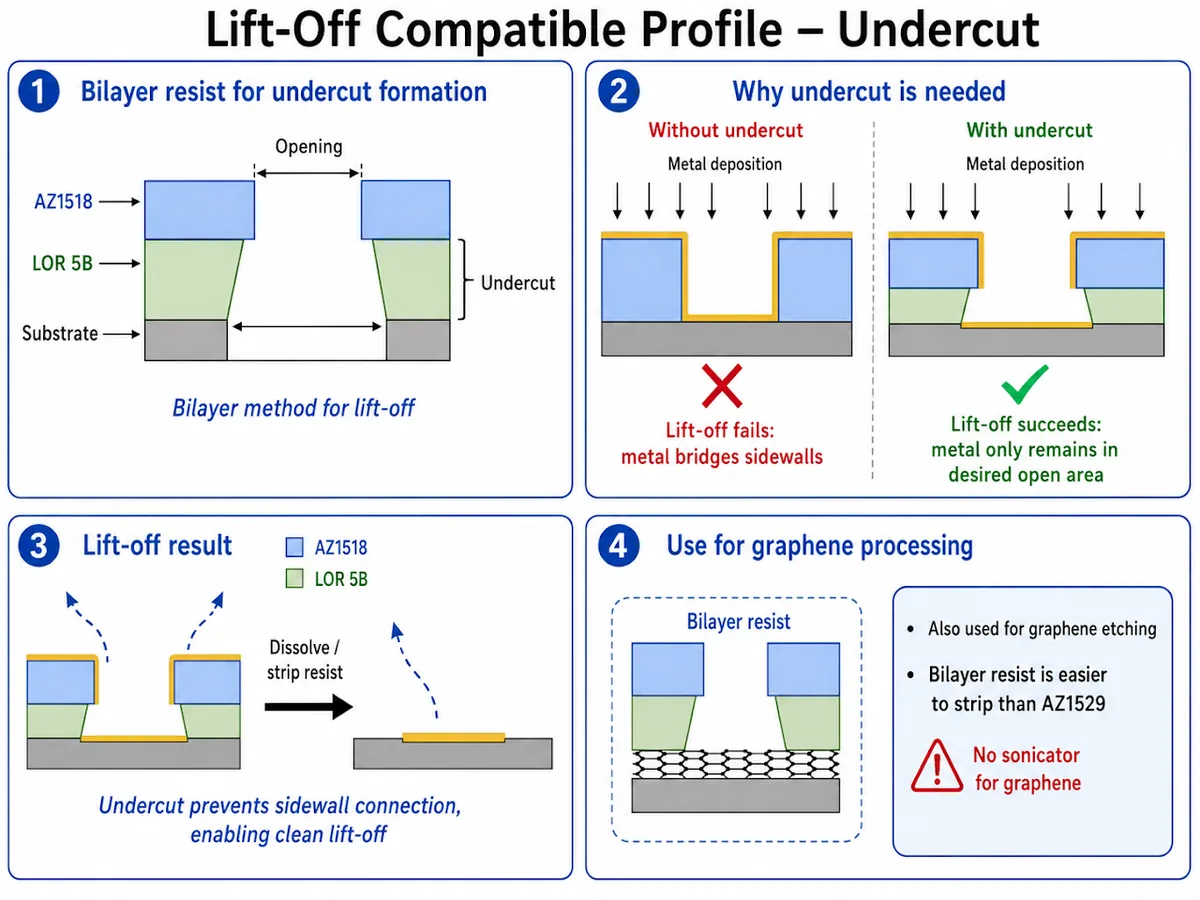
- For lift-off, the LOR5B and AZ 1518 bilayer creates an undercut profile.
- Without the undercut, lift-off fails because metal deposits on the sidewalls.
- The undercut lets metal coat only the open areas, not the sidewalls.
- The undercut is also used for graphene etching because the bilayer is easier to strip than AZ 1529. A sonicator can't be used on graphene.
Development
- AZ positive resists use an alkaline developer, AZ MIF 300.
- I use tank immersion: the wafer is fully immersed and the developer dissolves the exposed regions.
- To avoid overly aggressive development, the wafer is swirled gently for the right amount of time:
- Too short leads to underdevelopment.
- Too long leads to overdevelopment.
- Too much agitation causes nonuniform development, poor wetting or trapped bubbles, and resist lifting or pattern collapse.
- Right after development, the wafer goes into a DI water bath to stop development, then gets an N₂ dry.