1. Wet etch
- The wafer is submerged in or sprayed with a liquid that dissolves unprotected areas. Fresh etchant must keep reaching the surface, so the wafer is moved or the solution circulated.
- The wafer is dipped into a temperature-controlled bath of acid or base, or sprayed on a rotating chuck.
- The etchant reacts with the exposed solid, turning it into soluble or gaseous byproducts.
- The wafer moves quickly into a DI water bath to stop the reaction.
- Because wet etching is isotropic, it can't pattern features below about 3 µm. Dry etching is used instead.
Selectivity. Wet etch is highly selective. Etchants can be tuned to dissolve one material quickly while leaving others nearly untouched.
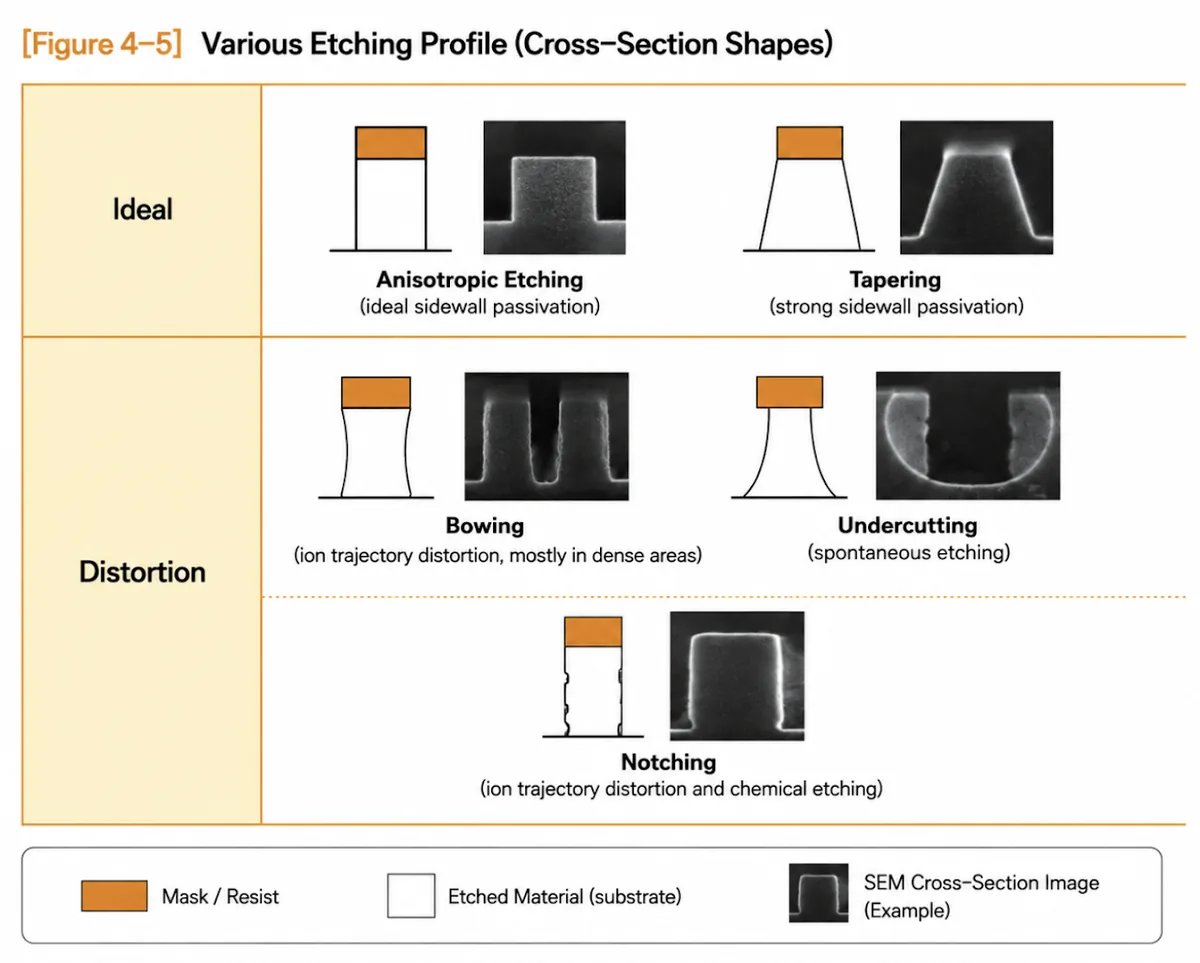
Isotropic. Wet chemicals dissolve material equally downward and sideways, creating a curved undercut profile.
2. Dry etch
Uses reactive gas instead of liquid, most commonly in a plasma.
| Type | Mechanism | Selectivity | Direction |
|---|---|---|---|
| Chemical etching | Chemical reaction only | High | Isotropic |
| Reactive ion etching | Ion bombardment plus surface chemistry | Medium | Anisotropic |
| Sputter (physical) etching | Inert-gas (Ar) ion bombardment only | Poor | Anisotropic |
Trade-offs
- Trenching: more etching happens near the mask edge.
- Sidewall passivation: if reaction products aren't volatile, they build up on the surface. Ion bombardment clears flat areas but not sidewalls, and the protected sidewalls allow anisotropic etching.
- Mask erosion: ions also etch the mask, so the selectivity between mask and target matters.
My cleanroom SiO₂ etch is written up on the reactive ion etching page.
3. Etch characteristics
Etch rate
Etch rate = etched thickness / etch time (Å/min)
- A faster rate means better productivity.
- Rate is controlled by the amount of reactive atoms and ions (gas type and flow) and by ion energy.
- Etch bias: dry etch still undercuts slightly. It's far less than wet etch but matters as devices shrink.
Selectivity
Selectivity (A/B) = etch rate of A (target) / etch rate of B (mask or substrate)
How well an etch removes only the target while leaving the mask or underlying layer intact. Higher is better, and both mask selectivity and underlayer selectivity matter.
Uniformity
How consistently material is removed across a wafer and from wafer to wafer.
Non-uniformity (± %) = (max rate − min rate) / (2 × average rate) × 100
A lower percentage is better. The target is under 1–3%.
- WIW (within-wafer): across a single wafer.
- WTW (wafer-to-wafer): across wafers in one chamber (one lot is 25 wafers).
- Lot-to-lot: across 3–5 lots.
- Tool-to-tool: across tools running the same process.
Why uniformity matters
- Yield loss.
- Punch-through: over-etching can breach the layer below.
- Critical dimension control: uneven etching changes trench widths and shapes, so chips on the same wafer perform differently.
4. Profiles